Blog · Pocket Notebooks
Field Notes vs LOCHBY vs Dialog Notebook: What I Use Each One For
Field Notes are my favorite pocket notebook, but the LOCHBY, the Dialog Notebook and the Leuchtturm1917 Bullet Journal Pocket each do a different job for me.
Here is a brief overview of the pocket notebooks I use on a daily basis and the job each one does.
Watch the full video for everything shown on camera.
For which one to carry every day, see my everyday carry notebook guide.
Short answer: Field Notes for daily capture, the LOCHBY notebook for fountain pens and a commonplace book, the Dialog Notebook for thin, special paper, and the Leuchtturm1917 Bullet Journal Pocket when I want more room to write.
Disclosure: Dialog sent me their notebook to try, and a friend sent me some of the Field Notes in this post.
| Notebook | Paper | Build | What I use it for |
|---|---|---|---|
| Field Notes | Standard Field Notes paper, thinner in this edition | Staples | Daily capture |
| LOCHBY pocket notebook | 68 GSM Tomoe River | Stitched | Commonplace book, fountain pens |
| Dialog Notebook | Thin Japanese paper, 5 mm dot grid, numbered pages | Two staples | Maybe an ink swatch book |
| Leuchtturm1917 Bullet Journal Pocket | Numbered pages | A6 size | A prayer journal, longer writing |
Field Notes: my everyday notebook
Field Notes are my favorite of the bunch. The covers are super nice, and they feel great and wear extremely well.
I've been using them for about a year and have gone through about 15 or 16 so far.
They fit in a pocket, so they go with me everywhere.
Often I carry one with nothing but my favorite pen, the Big Idea Design Base Line bolt action, clipped to the front cover, and put the pair in my pocket.
The pen's clip gives it a super deep pocket carry, so the top of the pen sits flush with the notebook.
The cover on the edition I'm using now is neither matte nor glossy, but somewhere in between. Its paper is 50 lb, a little thinner than the 60 lb Field Notes paper I'm used to.
I don't expect Field Notes to be very fountain pen friendly.
It is my daily-use notebook, where I write things down to get them out of my head and onto paper.
I love carrying them because they look great and wear in so nicely. That's my main use for Field Notes.
The other notebooks below are my way to try different, often higher quality papers, like the Tomoe River paper in the LOCHBY and the Kinbishi paper in the Dialog Notebook.
Best for daily capture. Skip it for fountain pen writing.
LOCHBY: the fountain pen notebook
The LOCHBY pocket notebook uses 68 GSM Tomoe River paper.
Its cover is plain cardboard, fairly flexible, with nothing printed on the inside or the back.
The notebook is stitch bound, which makes it a little more durable.
At 68 GSM, the paper is a little thicker than the Tomoe River paper in Hobonichi notebooks, which I believe is around 52 GSM.
I like that extra thickness because it doesn't bleed as much, so I can use my fountain pens.
It's a super nice notebook. I don't love the plain cover, which is why I keep it inside a LOCHBY cover.
The notebooks come in a pack of four, which is super convenient, and you can mix and match lined, dotted or blank insides.
The pricing surprised me. We all think of Field Notes as the cheaper option.
Once you divide the total cost by the number of pages, though, Field Notes and the LOCHBY are very comparable in price, even though the LOCHBY uses a much higher quality paper.
The LOCHBY is my commonplace book, and I love the Tomoe River paper for that.
Best for fountain pens and anything you want to keep. Skip it if you want a cover that looks good on its own.
The pen in my LOCHBY cover
The LOCHBY cover lets me carry the notebook and a pen together.
The pen is a brass one I've had for a few years. It was the first expensive pen I owned, and it has a super nice patina.
The ink I use in it dries super quickly.
That means I can highlight right after writing, in this case with Mildliners, and nothing smudges.
Dialog Notebook: the thin paper
I had been trying to get my hands on the Dialog Notebook because it uses a different type of paper, called Kinbishi.
In the hand it's a gorgeous notebook, and the paper is super thin.
The dot grid is super nice and not intrusive.
The design is very minimal: 62 numbered pages with a 5 mm grid. I had never heard of Kinbishi paper before, and it feels super nice.
There's a mark at the bottom where you can write which number notebook it is in your series.
The Dialog Notebook is staple bound, with two staples holding everything together.
I still haven't decided what I'll use it for.
I'm thinking about making it my ink swatch book, to keep track of my pens and all the ink colors I have.
Dialog sent me this notebook themselves, and I'm very grateful to them for letting me try it and review it on the channel.
If you want to buy one, I found it on Yoseka, which I believe is one of the few places that sells it directly in the US.
Dialog also ships to the US from Japan, but the wait is longer and you pay extra for shipping.
I can see why it costs more: it comes all the way from Japan, and you get high quality paper and thoughtful details like the numbered pages.
Best for trying a different, very thin paper. Skip it if you want the easiest notebook to find.
Leuchtturm1917 Bullet Journal Pocket: when I need more room
The Leuchtturm1917 Bullet Journal Pocket is an A6 notebook.
That makes it a little taller and a little wider than pocket size notebooks like the Dialog.
The extra size makes it perfect for writing longer entries.
Opened flat, a two-page spread is the same size as an A5 page.
That's super useful when I want to write a lot.
The Leuchtturm1917 Bullet Journal Pocket is my prayer journal, so I keep its contents private. It lives in a cover I got from Etsy a while ago, next to a book of prayers I carry with me.
I added the Leuchtturm1917 Bullet Journal Pocket to that cover a couple of weeks ago, and I'm loving the setup.
Best for longer writing in a small format. Skip it if it has to fit a pocket size cover.
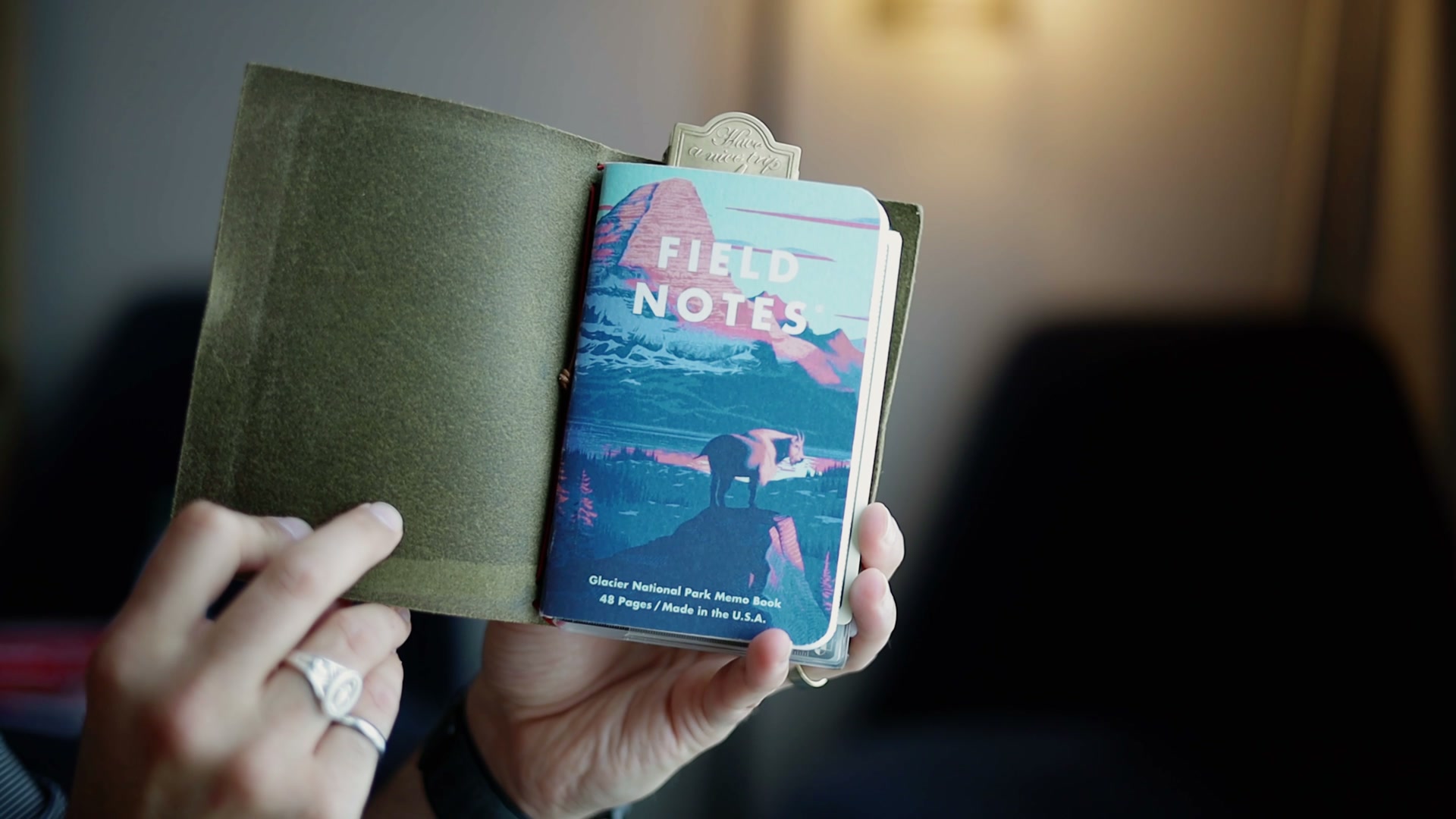
The cover I just started carrying
I recently got the Paper Republic Grand Voyageur in the pocket size.
I had seen it around enough that I wanted one for myself.
I got it in a beautiful olive leather that is super soft to the touch, and it's already developing some patina as I carry and use it.
Why I carry more than one
That's the beauty of having different tools in your arsenal: each notebook has its own job.
I get bored if I use one thing for a long time.
Trying different tools and different ways of doing things keeps me motivated to keep journaling.
The gear worth a look
- Field Notes: my everyday capture notebook.
- Dialog Notebook: thin paper, 5 mm dot grid, numbered pages.
- Big Idea Design Base Line Bolt Action Pen: the pen I clip to my Field Notes.
- Paper Republic Grand Voyageur (Pocket): the cover I had just started carrying.
Some links above are affiliate links. I may earn a small commission at no extra cost to you.
Related reading
- Best Pocket Notebook for Everyday Carry? I Carry Three Instead
- Best Field Notes Alternatives for Fountain Pen Users
- Pocket Notebook Covers: 7 I Have Carried and What Each Is For
Frequently Asked Questions
Are Field Notes good for fountain pens?
I don't expect Field Notes to be very fountain pen friendly. I use them as my daily notebook for quick capture, and I reach for the LOCHBY when I want to write with a fountain pen.
Which of these is best for fountain pens?
Of these notebooks, the LOCHBY pocket notebook is the one I reach for with fountain pens. Its 68 GSM Tomoe River paper doesn't bleed as much, so I can use my fountain pens in it.
Why use more than one notebook?
I get bored if I use one thing for a long time. Trying different tools and different ways of doing things keeps me motivated to keep journaling.